

Prologis: The Logistics Leader Bets on Data Centers to Accelerate Growth
From global logistics to data centers: why Prologis can continue to command a premium multiple

Company Profile
Few companies better represent the evolution of modern logistics real estate than Prologis. Today, the group is one of the leading global platforms dedicated to logistics, supply chain infrastructure, and real estate logistics, with a model built around properties located in highly strategic areas near major cities, ports, airports, and commercial hubs.
In very simple terms, Prologis owns, develops, and leases logistics properties to corporate clients, including retailers, e-commerce operators, transport companies, manufacturing firms, and distribution players. Furthermore, in recent years, the company has begun expanding its scope into adjacent areas such as data centers, energy infrastructure, and services connected to the modernization of supply chains.
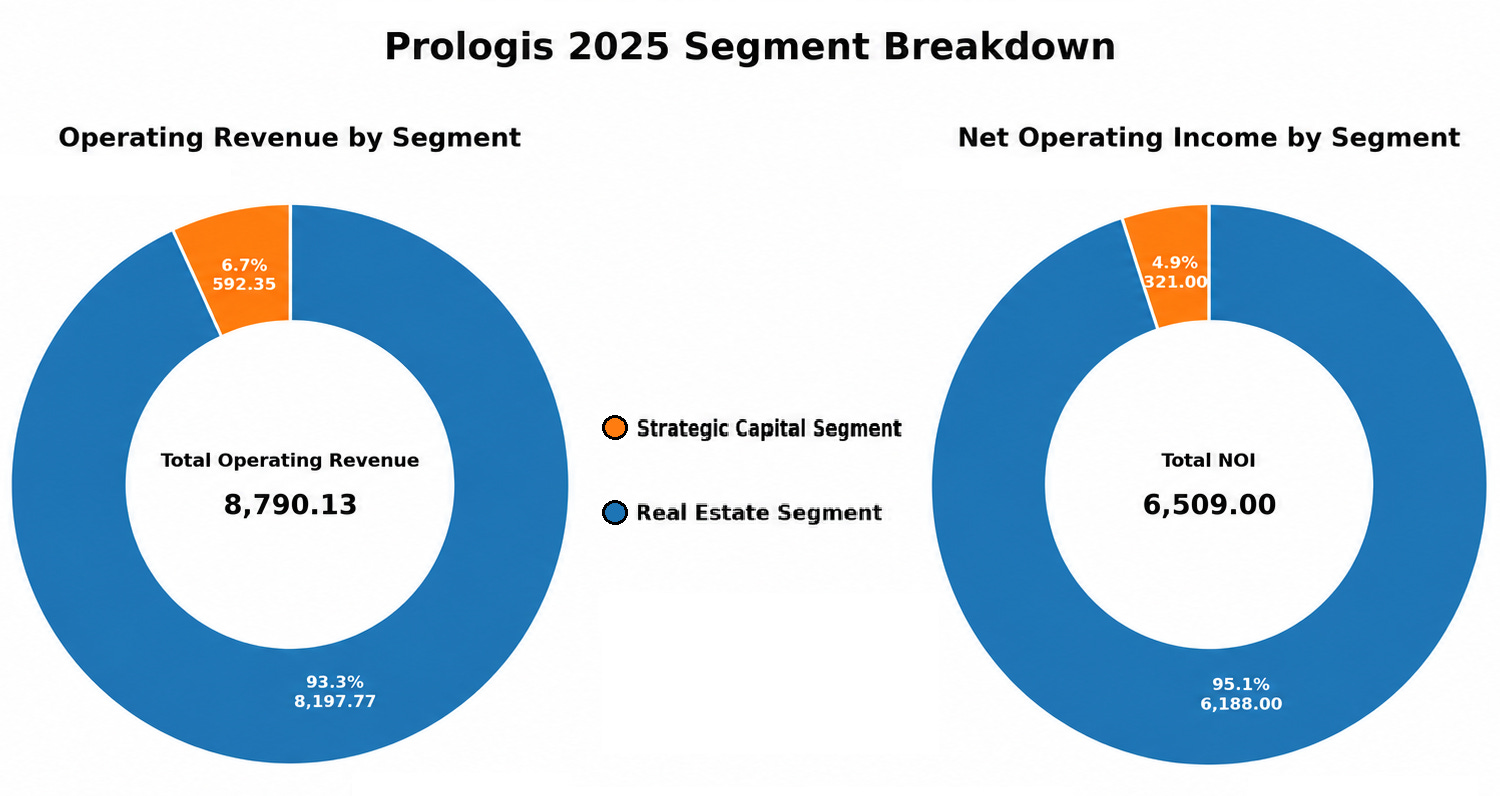
From an accounting and organizational standpoint, Prologis reports two reportable segments: the Real Estate Segment (93.3% of revenues and 95.1% of NOI) and the Strategic Capital Segment (6.7% of revenues and 4.9% of NOI). This point is important because real estate development does not constitute a third, autonomous business line; instead, it is part of the Real Estate Segment, which encompasses both Rental Operations and Development activities.
The Real Estate Segment represents the economic core of the company. This includes property ownership, the generation of rental revenues, operational management of the portfolio, and the development of new assets. In 2025, this segment generated $8.20 billion in revenues, accounting for 93.3% of total Operating Revenue, up from $7.53 billion in 2024. Nearly all of these revenues come from rental revenues, which amounted to $8.159 billion, while development management and other revenues contributed $39 million. After deducting rental expenses (costs related to managing leased properties) and other expenses, the segment produced a Real Estate Segment NOI of $6.188 billion, equal to 95% of total NOI. NOI, or Net Operating Income, is the net operating income generated by properties—a key metric of asset profitability before corporate costs, depreciation, and other items not directly related to property management, which is essential for evaluating companies like Prologis.
These numbers clearly demonstrate the nature of Prologis’s business: the company relies primarily on a large portfolio of logistics assets capable of generating recurring revenues with high visibility and strong operating cash flow capacity. At the same time, the presence of development activity makes the model more dynamic than that of a simple property owner. Indeed, Prologis does not just collect rent; it develops new properties, executes build-to-suit projects for clients, and unlocks value from its land bank (portfolio of strategic land) in areas where the availability of quality logistics space is often limited.
The Strategic Capital Segment is much smaller in terms of revenues but holds significant strategic importance. In 2025, it generated $592 million, representing 6.7% of total Operating Revenue, down from $672 million in 2024. Net of strategic capital expenses (costs related to managing the third-party capital platform), the segment recorded an NOI of approximately $321 million, accounting for 5% of total NOI. Through this segment, Prologis manages third-party capital via joint ventures, private vehicles, and partnerships with institutional investors. This allows the company to expand its investment capacity, generate fee income, and grow more efficiently without having to fund every project entirely through its own balance sheet.
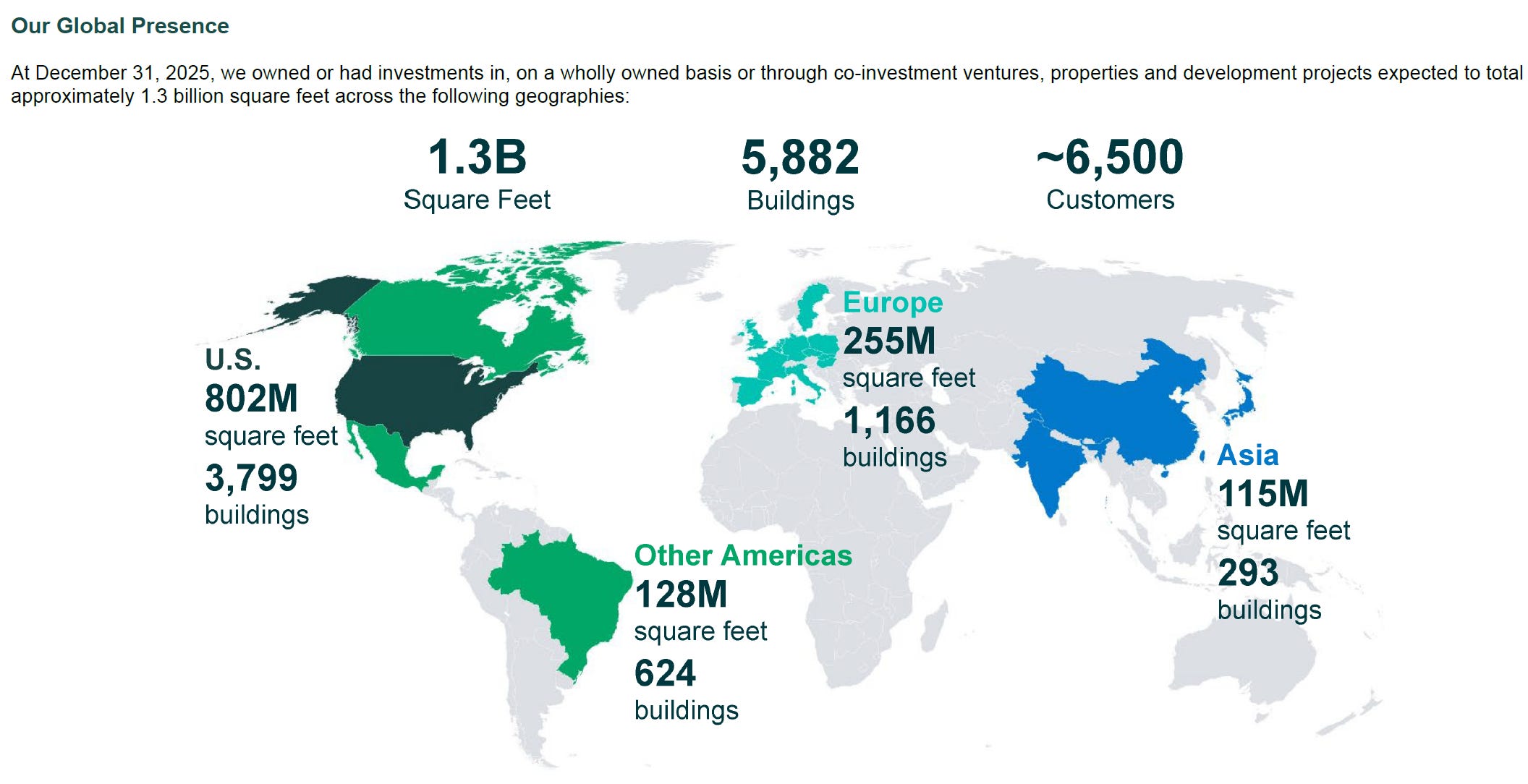
The geographical distribution of revenues shows a global company, but one that remains heavily centered on the United States.
In 2025, the U.S. generated approximately $8.00 billion in Operating Revenue, accounting for 91.0% of the total. This was followed by Europe at $356 million (4.0%), Other Americas at $283 million (3.2%), and Asia at $150 million (1.7%). The U.S. concentration is even more pronounced in the Real Estate Segment, where the U.S. represents approximately 95.2% of segment revenues, compared to 2.4% for Other Americas, 1.7% for Europe, and 0.8% for Asia.
